Category: PASS

PASS Summit 2013 Interview with Matt Masson

At PASS Summit 2013 in Charlotte, I had the opportunity to sit down with Matt Masson (Blog|Twitter), Senior Program Manager on the Integration Services Team at Microsoft. I was really honored when Matt explained how busy his week was and then offered me a half hour anyway. I want to give a tremendous THANK YOU to Matt for being so generous with his time.

I had no grand plan/agenda for my series of interviews of Microsoft folk at PASS Summit 2013. As such, I plan to just display the transcript of my conversation with Matt as it occurred. NOTE: With Matt’s permission, I have edited out “Um” and “Ah” and other byproducts of casual conversation so that it flows better in writing.

The Transcript

Mark V

With the way things are going, with Cloud, and everything else going on, what does the future of SSIS development look like 5 years down the road?

Matt

I think five years out is a bit too far. We’re seeing a lot of big changes, especially around Hadoop. I think Hadoop and Big Data processing have been a big disruptor to the ETL space. I think there’s still a lot of what we call “traditional” ETL work, what people do today with SSIS. That’s where SSIS’ strength is. But we’re getting more and more requests about Cloud processing. That’s actually one of the things I’m going to talk about at PASS today, at the SSIS Roadmap session. One of the interesting things is, say, go back two or three years ago, we had people asking, “Can I have SSIS running in the cloud? Can you make SSIS run in the cloud?” And we’re like, “Yeah, that’s a great idea. Let’s go build it.” And then we started asking, “What scenarios?” and “Why do you want to run SSIS in the cloud?” Customers didn’t know. OK. Where’s your data? Data is all on prem. If your data’s all on prem, running in the cloud doesn’t necessarily make sense, right? I think, as we’re seeing a shift of more and more data to cloud sources, so they’re landing in places like Azure, or even pulling in from remote sites or pulling in from different cloud providers like Salesforce.com or something like that. If your data’s already IN the cloud, then doing your ETL processing closer to that data makes a lot of sense. So, today, you can run SSIS in an Azure VM and we’re having a lot of customers do that. So, you’re using your traditional On-Prem tools. It’s just running in the Cloud.

Other things we’re considering and looking at is, basically, what if SSIS could run as a service? What if you didn’t need your VMs? You could just deploy your packages and run things like that?

In addition to traditional ETL, we’re also looking at other technologies. There’s other data movement technologies out there like Azure Data Sync, which is very simple: I want to keep my On-prem databases and my Azure databases in sync. So, you don’t need a full ETL framework. You don’t need an ETL developer. Sync just takes care of it for you automatically.

So that leads us to a couple of different angles. We’re trying to make ETL easier, more automatic. Just keep schemas in sync. While for the more advances scenarios, your traditional ETL scenarios, SSIS still makes a lot of sense. We need to evolve SSIS to better fit in the “Cloud” world.

Then there’s Big Data and Big Data processing. You’re seeing an of evolution of technologies on Hadoop, right? There’s a lot of different technologies, lots of things going on. You’re seeing lots of tools at different stages of maturity. It’s a really interesting space to see how it’s evolving. One of the things I’m going to talk about today is to show SSIS integration with HDInsight, for example. So, from SSIS, you can provision HDInsight clusters, you can run Hive jobs, Pig jobs. You basically orchestrate everything you want to do on Hadoop from SSIS. You get the nice visual experience which is lacking from Hadoop and the Big Data system today.

Mark V

So, when you think about Hadoop, and the Cloud, and the Democratization of data; bringing BI to the Masses; the revolution of Self-Serve, one of the things you have is Users looking at data that they may not know how to vet properly. So, when I think of tools like DQS (Data Quality Services) that are often integrated into ETL, what are some of the things that we could look for in the future? Not necessarily products, but just concepts for how Microsoft is going to help handle that with moving data around to enable that Self-Service, while still keeping it easy to get to.

Matt

So, Self-Service is an interesting space. We have Power Query coming out, which gives you self-service, light-weight ETL. I think our self-service vision has been resonating really well. We’re seeing more and more customers picking up on that. But, just like there’s a space for Self-Service BI, but also a need for traditional BI modelers to take that raw data into a model concept so that the “self-service” people can actually build their reports from there, I think the same thing applies in the ETL space as well. There’s Power Query for that light-weight, self-serve ETL, but there’s still the need for traditional ETL development as well for IT to automate these processes, make them reliable, do the complex transformations, apply business logic, apply filtering, etc. I think there’s going to be that “professional” or “corporate” ETL as well as self-serve ETL. That challenge for us is figuring out whether that is a single tool that does both; perhaps a single tool with different faces or personas, for different roles. I think we’re going to see a lot of convergence in our tools going forward. I think one of Microsoft’s strengths is the rapid time to results, making it as easy as possible to get it, and also have that functionality there that you can extend to do the more complex ETL scenarios as well.

Mark V

One of the other things you’re really known for is the BI Power Hour. Can you talk a little bit about how that was born and how it’s evolved and what it’s like to be a part of something like that?

Matt

Sure. The BI Power Hour is really interesting and I was nowhere near the beginning of it. I think it was Bob Baker who started the original Power Hour and it was focused around Office BI. And then the SQL folks eventually took over. But the idea was to let the Product Team have fun and show off the power of the products in your non-typical scenarios, with no business value whatsoever. And we’ve sort of made it more and more ridiculous as time goes on. There are certain teams, like Reporting Services, that have always been there since the beginning, and they always did a game. Every year they did a game. I think they did Tic Tac Toe, and then Hangman; the game got more and more complex as they went through the years. I think I saw my first Power Hour in 2009 and I immediately wanted to be a part of it. I had never seen one before and I just thought it was really exciting. And the next year, I asked the organizer, Pej Javaheri, if I could participate. He wasn’t sure; “SSIS doesn’t usually do a Power Hour” and “it’s not very interesting.” So, I decided to prove him wrong. Since Pej left Microsoft, I’ve taken over the Power Hour. I do most of the coordinating and stuff. It’s always really interesting to make sure there is a business message there. We’re not as explicit about it anymore. But, afterwards, we always have people coming up to us and saying, “I didn’t know the tools could do that” and “I want to know more.” That’s really the whole point, essentially. And if we can get laughs doing it, then that’s even better. We usually try to balance out presenters showing new technology, show off some valuable things. I typically just do ridiculous demos. I have a whole story that goes along with it. It’s a lot of fun. The hardest part is justifying the days of work that goes into a ten minute demo.

Mark V

It’s really exciting to see people who were involved in building the tools and are just so excited about features getting to go play with them.

Matt

With my demos, which usually revolve around cats, I had spent some time in SSIS and built some custom transformations. I’ve had someone ask me afterwards, “Why do you spend so much time on this? Why aren’t you doing work for the real product?” Yeah… it is a good point, but usually I limit Power Hour stuff to my “free time.” So flights, at home, things like that is usually when I work on those things. I try to really time box it, to justify to myself, devoting time to this really fun thing.

Mark V

When I saw you at TechEd and you were talking about the SSIS Catalog, one of the things you said was that there was some debate within Microsoft regarding the Package Deployment Model and the new Project Deployment Model. Even within the team, people were arguing about which way to go, and you were finally brought around to the Project Deployment Model. Is that something that is common when you are getting features ready for a product that you have that kind of debate? Is there a lot of that?

Matt

Yes, there’s a LOT of debate. The bigger the team, the more debate there is. 2012 was really interesting because that was as big as the SSIS team has really been. We actually had half our team located in Shanghai and they were really driving the Server components. And half our team located in Redmond. So, doing the coordination and making sure both teams agreed on the scenarios of what we were trying go toward was really important. Doing development is all about resource constraints, right? You have a ton of stuff you want to do and you have to figure out, “Where is my time best spent?” Sometimes you’re making guesses. If you only do exactly what the customers want, you’re not necessarily moving your platform forward far enough. If we only focused on bug fixing, we probably wouldn’t have gotten a lot of the great functionality that we did out of 2012.

Mark V

…And the rounded corners…

Matt

Well, the rounded corners, yeah. Actually the rounded corners joke was just a random Power Hour joke that I just came up with on the fly. I’ve been using it since. Although I was in somebody’s session and they spent ten minutes building up that joke and it was really painful to watch. But the rounded corners was just WPF, that’s just the way it looked. But I made the joke about Interns coming in and sanding down the corners for three months. And I actually had an angry customer come up to me afterwards and say, “You guys spent three months working on rounded corners and yet you didn’t fix the Web Services Task” and storm off. “It was a JOKE!” At PASS, people usually get that something’s a joke. At Tech Ed, people expect Microsoft presenters to be more serious and jokes don’t always go over well.

Mark V

Even at a BI Power Hour?

Matt

When I did my first BI Power Hour at Tech Ed, I got a standing ovation when I did some of my lines, not because it was a great presentation, but I think the line was “I’m a programmer. What do I need real friends for when I can create them programmatically?” Standing ovation. And it wasn’t because it was funny. It was because the audience felt the same way. And I just felt really sad at that point. And the next day, I had people coming up to me offering to be my friend and saying, “I don’t have any friends on Facebook either. I had to stop using it.” And they just didn’t get that it was a joke. I did my Power Hour at the Boston user group and nobody laughed. There were some chuckles, but that was it. But then I realized afterwards, when I was talking with somebody else, that the audience actually thought it was real and that they felt sorry for me. So, they didn’t know they were supposed to laugh.

Back to planning. There are definitely different viewpoints on the team. One thing was related to Package Deployment versus Project Deployment. Every time you change functionality, but keep supporting a feature, your Test Matrix increases. So, the number of scenarios you have to test goes up. And we were really short on Test resources. And you can’t release something unless it’s properly tested. So, at one point, they wanted to say “No more Package Deployment Model; we’re just going to do Project because it means we can add more functionality because we’re not supporting these other things anymore.” It just did not make sense to take approach. I think the thing I had mentioned at Tech Ed was Single Package Deployment versus Full Package deployment. Long debates. But it came down to the architectural difference. We showed how much it would cost to implement Single Package Deployment and how much it would cost without. If it’s an extra month in development time, how many bugs can we fix in a month? How many other improvements can we make in a month? So, it’s a balancing act. I still think it’s the right decision. At the same time that we’re making those decisions internally, we’re talking to our MVPs, getting their feedback. I know the MVPs felt really strongly about Project Deployment, keeping it all together. And we were trusting in that. They’re basically the voice of our customers.

Wrapping Up

With Matt being so busy, and prepping for a session, I left the interview off there.

I have only had the chance to use SSIS 2012 one one project. And even with that small taste of this fabulous tool, I was tempted to just give Matt some applause and call it a day. I really appreciate the work and time that went into making SSIS 2012 such a tremendous improvement over previous versions of Integration Services.

I think Matt made some really great points here. The Big Data revolution was certainly a “disruptor” to common ETL. When dealing with data that is aging too quickly or in quantities that make taking the time to bring it into a data warehouse impractical, that certainly would disrupt common thinking around traditional ETL. While, as Matt points out, the need for traditional ETL will remain, there is some need on the part of those of us in the industry to re-assess what ETL looks like in some cases. It’s not always going to be a series of SSIS packages running on a server and populating a data warehouse. Sometimes, it will be information workers using Power Query to bring data from many sources into Excel.

As far as the Power Hour, that holds so many features that I strive to put into my own presentations. Humor is a huge one. There is a lot of research that shows that people learn better when they are having fun. Not to mention that an audience that is having a good time is less likely to throw rotten tomatoes; they stain, you know. Combine that with using features of the tools in creative ways, and you’ve really got something. I love finding new and exciting uses for technology. I often think of Ed Harris’ great line as NASA’s Gene Krantz in Apollo 13, “I don’t care what anything was DESIGNED to do; I care what it CAN do.”

I liked hearing from Matt that there is often a lot of debate within the SSIS team when it comes to features. it should remind all of us of time spent on project teams in our own work. The point this raises is that we need to remember that Microsoft, like any other organization, has finite resources that need to be spent in the best way they can. I hope we can all keep that in mind when we wonder why certain features haven’t gotten much love or don’t work the way we would want them to.

Matt’s point about MVPs is an important one. Along with what prestige may come from receiving the MVP award, there is also responsibility to serve as a voice for the Community as a whole. Being an MVP is not about getting to wear that MVP ribbon at Summit or a pretty trophy; it’s about leadership, with benefits and obligations along with it.

That brings us to the end. Even though my second interview was with Kamal Hathi, that happens to be the longest one as well. Since I have the typing skills of a rainbow trout, transcribing the audio for these interviews is a long process. As such, I will aim to have the post on my interview with Kasper de Jonge (Blog|Twitter) next week and the one with Kamal the week after. Thanks for your patience.

PASS Summit 2013 Recap of Madness and Mayhem

Greetings! Another PASS Summit has come and gone. This was my third Summit and I have to say that I am truly hooked on this spectacular event. I had the privilege to be a bit more involved this year than in years past. I love when I can give some of my time and energy to help out an organization that has been hugely important for me in my career with SQL Server.

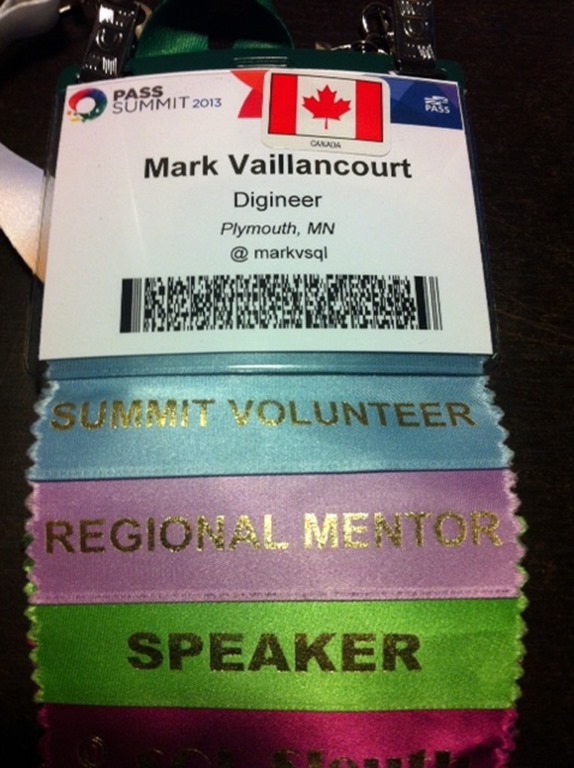
I spent much of Tuesday in meetings related to the PASS organization. There was the Regional Mentors meeting, the Chapter Leader meeting, and a chance to sit down with the Canadian Chapter Leaders. As a PASS Regional Mentor for Canada, that was great since I don’t often get the chance to see them in person.Summit 2013 Badge

Since it was already confirmed on Twitter, I would like to say that I will be working with SQL MVP and Winnipeg  SQL Server User Group chapter leader, Mike DeFehr (Blog|Twitter), on planning a SQL Saturday in his fine city. I am hoping I will get to go as well. I have never been involved in running a SQL Saturday and I thought helping Mike would be a great way to fulfill my role as a Regional Mentor and also give me the experience to better help others with their event planning in the future.

PASS invited me to be on the Blogger Core and have a seat at the Bloggers table for the keynotes this year. While it can be challenging to keep up with meaningful things to post while live blogging, I really enjoy it. I always get a lot out of it. You can read those posts at PASS Summit Keynote Live Blog – Day 1 and  PASS Summit Keynote Live Blog – Day 2 respectively.

When PASS invited me to serve on the Blogger Core, they also indicated I would have access to an Interview room. I had never interviewed anyone before, but it seemed like a great opportunity to capitalize on connections I had made at PASS BA Conference, Tech Ed North America, and past PASS events. I decided, with the fast pace of change occurring in Business Intelligence both at Microsoft and in the industry as a whole, that I should try to sit down with prominent Microsoft personnel to talk about their work and the future of Microsoft BI. Being a lowly blogger from Minneapolis, I didn’t expect to get very far, but I had to try. I was astonished at the access I was given. Listed in chronological order of when the interviews took place, I sat down with:

  • Matt Masson (Blog|Twitter), Senior Program Manager for SQL Server Integration Services
  • Kamal Hathi, Director of Program Management for Microsoft Business Intelligence
  • Kasper de Jonge (Blog|Twitter), Program Manager for SQL Server Analysis Services

I know! Right? For real.

Transcribing the audio from these interviews is taking a little time. Each interview will get its own blog post. I hope to have the first one released next week. I have to express my great appreciation to Matt, Kamal, and Kasper for giving of their valuable time to chat with me. I also need to say thanks to Microsoft’s Cindy Gross (Blog|Twitter) for helping with my connection to Kamal Hathi.

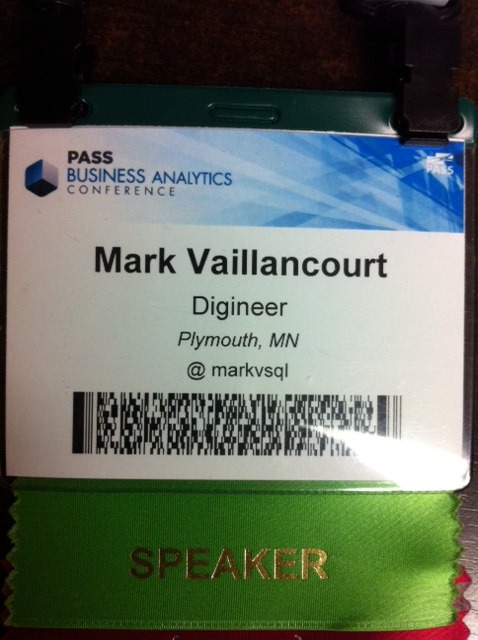
I also had the honor of wearing a SPEAKER ribbon on my Summit badge this year. It was my first time speaking at PASS Summit; a career milestone to be sure. I am happy to report my presentation, DANGER: The Art and Science of Presenting, went extremely well. And, despite presenting right after Dr. David DeWitt’s brilliant keynote and being on the other end of the Convention Center, there were very few empty chairs in my room. The feedback I have received so far is all very positive. Thanks to all who chose my session when there were so many great options to choose from.

While I ended up having to miss the public Q&A Session with the PASS Board of Directors, I do have some notes from the private Blogger Q&A with the executive committee. I will prep that for another post.

If you ever get the chance to go to PASS Summit, grab onto it with both hands. There’s nothing like connecting, sharing, and learning with a few thousand of your closest friends to get you jazzed about what you do.

GO

Upcoming Presentations and More

Wow. I have the tremendous joy to have 4 presentations coming up in the next few weeks. I love when that happens.

October 12 – SQL Saturday #238 Minnesota

I will be giving two sessions at the SQL Saturday here in sunny Minnesota.

1. MDX Trek: First Contact

2. DANGER: The Art and Science of Presenting

PASS SUMMIT!!!! For Real!

I get to give my first Summit presentation ever. I’m really excited for this.

3. DANGER: The Art and Science of Presenting

In addition to presenting, I will be on the Blogger Core, live blogging keynotes and sharing my observations all week long on Twitter. I also have the great privilege of getting interviewed on PASS TV! My interview will be from 4:30pm to about 4:45pm (Eastern) on Wednesday, October 16th. I am sure I will also be spending plenty of time in the PASS Community Zone. Please stop on by and say hi. Meeting new people is one of my favorite things to do at PASS events. I volunteered to host a Birds of a Feather Lunch table as well. That should be tons of fun. It’s going to be quite a week. 🙂

October 19 – SQL Saturday # 237 Charlotte BI Edition

I will be staying an extra day in Charlotte to present at the SLQ Saturday.

4. MDX Trek: First Contact

All in all, it will be quite a busy time.

A Milestone: Presenting at PASS Summit

I have been presenting for several years. I can’t properly explain how much I love it. Since before I even attended my first PASS Summit, it has been a career goal that I would one day present at the premier SQL Server focused training event on the planet. When I got the email a while back that my DANGER: The Art and Science of Presenting session had been chosen as an Alternate for the 2013 Summit, I was pretty happy. It was my best result yet.

It is with tremendous joy that I now report that I am no longer an Alternate. Due to a cancellation, PASS had an opening in the Professional Development track and asked me to fill it. Not only do I get to fulfill a career goal of presenting at the Summit, but I get to do so with an exciting new session. I honestly feel this session will not only help new presenters get started on the right foot, but will also help re-invigorate more experienced folk.

You can read the abstract for it here: DANGER: The Art and Science of Presenting

PASS_2013_Banner_300x250

SQL Saturday #239 East Iowa Recap

I just returned home from a fantastic SQL Saturday in Iowa City. Ed Leighton-Dick (Blog|Twitter) and his team did an excellent job. Many thanks to them and to all of the folks that worked so hard to make this event what it was. FamAtFieldOfDreams

I had the joy of presenting twice. In first time-slot of the day, I co-presented Hailing Frequencies: Analysis Services Terms and Concepts with my friend, Doug Lane (Blog|Twitter). In the final time-slot, I gave my MDX Trek: First Contact presentation. Both went well and I want to thank those who attended these sessions when there were other great topics to choose from. I LOVE presenting and the chance to do it twice at a single event was outstanding.

In addition to presenting, I went to great sessions as well. Ed Leighton-Dick gave an excellent introduction to Service Broker, a topic near and dear to him. It was very clear and concise and provided troubleshooting tips and lessons learned. I also went to a great session by Time Mitchell (Blog|Twitter) on SSIS Incremental Load Design Patterns. In addition to quality content, there was meaningful discussion. I went to Doug Lane’s session, From Minutes to Milliseconds: High-Performance SSRS Tuning. Doug gave great tips on memory/IO as well overall architecture choices. I learned valuable new things in every one of these sessions.

In addition to seeing #sqlfamily down in Iowa, I brought my wife and kids along this time. We stopped at the Field of Dreams baseball field in Dyersville, Iowa on the drive down from Minneapolis. That was really cool. My wife, a far bigger baseball fan than I am, absolutely loved it. Actually, she is watching that movie with my ten-year-old as I type this. 🙂 It was great to turn a SQL Saturday into a mini-vacation for my family as well. If you have a chance to do that some time, I highly recommend it.

SQL Saturday is such an important part of PASS and the overall #sqlfamily. It makes me so happy to see how SQL Saturday has grown so mightily over the years and spread across the world. That wouldn’t happen without people like Ed Leighton-Dick and his team who put in so much work to make these events happen. The people that give so much of themselves to put on these events deserve our Thanks and appreciation. 🙂

PASS Business Analytics Conference–Recap

PASSBAC NameTagThe very first PASS Business Analytics Conference (PASSBAC) has come to an end. And it was fantastic. Since you follow my blog with rapt joy, you know that I had the great honor of speaking at this shiny new event. While I have spoken many times to user groups and several SQL Saturdays, it was my first time speaking at an event of this caliber. While I was certainly nervous about presenting, I was even more excited. I LOVE presenting. And I feel comfortable in saying it is something I am pretty good at. While my co-presenter, Doug Lane (b|t), was very appreciative of my asking him to present with me, I must confess that his advice on writing abstracts was invaluable in our getting selected. I met Doug at a SQL Saturday in Chicago a few years ago. It was great to share this honor with a friend from my #sqlfamily. I do want to send special thanks for Joe D’Antoni (b|t) and Scott Stauffer (b|t) for their efforts in coming to my aid the night before the biggest presentation of my career.

Speaking wasn’t the only first for me at PASSBAC, nor was it the only thing I had the honor of sharing with a friend from my #sqlfamily. In 2011, I attended my very first PASS Summit. At that time, I took part in a program for first-time Summit attendees called First Timers. This featured having a Summit mentor as well as taking part in extra networking events. At one of these networking events, I met Angel Abundez (b|t). At PASSBAC, Angel and I both had the honor to be invited to sit at the Bloggers table to Live Blog the keynotes. On Day 1, I sat down next to him and we had a moment of, “Wow, we’ve come a long way in a few years.” You can read Angel’s Live Blogging here. To me, that transformation from First Timer to Bloggers table is more than just the fact that we are both seeing solid growth in our careers. It also speaks of how open and inviting the SQL community is. I often hear that people in other industries and even other groups within the technology sector are just in awe of what we have going on. PASS is an important part of that.

I have to say that I was not only honored that PASS asked me to participate in the Live Blogging of PASSBAC, I was nervous. I had never done that before and wasn’t really all that sure what it would entail. I ended up getting some great advice from John Sansom (b|t) and Jason Strate (b|t). John provided me with a blog post of his about Live Blogging that was really helpful. At the end of that post, John links to a Live Blog from the 2011 PASS Summit by Brent Ozar (b|t). I looked at that post and thought, “Sweet mother of Abraham Lincoln! How can I even come close to matching that?” There are lots of pictures and great commentary. Even if I had convinced my wife to let me take her camera, I would be more likely to drop it on my foot than capture anything of value quickly enough to add it to a live blog post. Then I realized that there was no reason I had to try to match what Brent or any other person had done. I did see that Jason had kept it pretty simple in his Live Blog of the Day 3 keynote of PASS Summit 2011. I figured I would start simple. I set up the Live Blogging plugin for my WordPress blog and decided to try to keep my entries short enough to cross-post them on Twitter. It turns out that was a good choice as so many people told me how much they appreciated what I was doing. I was honestly blown away by the feedback I was getting for my efforts. I even noticed that the PASSBAC homepage was featuring my live blogs of the keynotes. Thanks so much to everyone who followed and expressed their appreciation in one way or another. You can read my Live Blogs from PASSBAC Day1 and Day2. On Day 2, I even got the timestamp working. Yay. As you can see, the keynotes were awesome, from my perspective.

My choice to cross-post to Twitter ended up being a great one from a networking standpoint. It turns out that only the @passbac account itself had more #passbac tweets than I did, according to ExtrendedResults.com, who provided Twitter analysis for the conference. In addition, the analysis performed by iTrendTV showed that I was in the Top 5 in both “Largest Audiences” and “Most Engaging Authors.”  Notice Angel in there with me and some fine company.

My point here is that we need to remember that the I in ROI means “investment.” That investment doesn’t always involve money. Sometimes it means we stray out of our comfort zone or take a risk by doing something new in a public setting. In my case, I was confident that live blogging was a great opportunity that I had to take. I looked at overcoming my trepidation as the investment toward the ROI of increased connections in the industry. I knew that doing a decent job with the live blogging had a good chance of leading to expanding the network of people I value so much.

I had a tremendous amount of fun Live Blogging. I hope I get invited to the Bloggers table for more events in the future.

On the morning of Day1, SQL Sentry hosted a breakfast and informal discussion on Business Analytics emceed by Kevin Kline (b|t). The panel was made up of the following great experts:

Chris Webb (b|t)
Craig Utley (b)
Jen Stirrup (b|t)
Paul Turley (b|t)
Stacia Misner (b|t)

It was great discussion that could have gone on a few more hours and I would have been happy to stay for it. Thanks much to SQL Sentry, Kevin and the great panelists.

I went to fantastic sessions by Jen Stirrup (b|t), Jason Thomas (b|t), Angel Abundez (b|t), Craig Utley (b), Ayad Shammout (b|t) and Denny Lee (b|t), and more. I spent a lot of time learning more about Excel features and geo-spatial topics like GeoFlow.

Overall, the event was just amazing. I am so glad I got to go. The fact that I got to participate in a meaningful way makes it even better. I really want to thank all the people in PASS HQ, Board Members, Sponsors, Program Committee and everyone else who worked so hard to make this event happen.

PASS Business Analytics Conference – Live Blogging – Keynote Day 1

Greetings! I have had the great honor to be asked to Live Blog the Keynotes for the PASS Business Analytics Conference here in Chicago. Behold!

All set for the keynote to start.

PASS President Bill Graziano taking the stage.

Gartner: Business Intelligence is growing faster than any other business area.

Connect-Share-Learn: Working together is key for success.

Virtual PASS Chapters rock. Take geography out of the equation.

…and the puns just keep on coming…

HUGE thanks to Sponsors and Exhibitors. This couldn’t happen without you!

Matt Wolken from Dell taking the stage to discuss the promise of Analytics.

Dude, you’re getting a Dell.. keynote speaker. Cool.

Who is the “average” social media user? Unlike Trix, it’s not just for kids.

Key social media users are those that control the money/budget.

People closest to the action ARE the authority today.

Analytics used to be about executives looking back. Now it is about finding new customers.

Companies implementing BI are 13% more profitable than their peers.

57% of all CIOs say they plan to expand BI this year or next.

Business Analytics shifting to be seen as a revenue source. People work for your company; your data should work too.

Data no longer sourced just INSIDE organizations. So much out there you can bring in to complement what you already have.

“Dell now has software”

Now consuming many different types of data: structured, semi-structured, text, etc… How to manage all that at once?

SO much data sprawl in organizations. People have their own versions of truth their way. Key is to integrate and share.

Dell has been one of the leaders in listening for the brand via social media. What are people asking? What can we do about it?

Dell is turning data on conversations into actionable insight. Stay ahead of the curve to change features before issues arise.

Microsoft speakers Amir Netz and Kamal Hathi taking the stage now.

Amir’s parents spent 6 months salary to buy him his first computer, an Apple IIc with TWO disk drives.

That experience changed his life and led to working with Data.

That story is prime example of an investment in enabling users. The payoffs are there.

Kamal discussing his history with CompuServe. Lots of data there, which led him to Microsoft.

So many idea in data now. How can a business user make sense of what tools to use when there are so many? Simplicity.

Behold: the Spreadsheet. Back to Excel. #ISeeWhatYouDidThere

Data Explorer taking the stage now. Again, finding data from Outside the Organization to complement that from Inside.

Data Explorer is essentially collaboration with the world via the Internet.

THIS is AMERican Idol data. Very big data.

Advertisements for the Model T were not about driving. They are about tinkering and tools. Mechanics.

Contrast with recent BMW ads: The Ultimate Driving Machine. Different focus.

The Elephant is in the building. HDInsight for the win. #hadoop

Let Excel turn your data into information. Turn raw data into columns for ease of use.

What kind of Pivot? Well, #PowerPivot, of course!

Simplicity: Working with Big Data in Excel without dealing with MapReduce, or any of the other dev tools, etc. Excel can do it.

Amir’s kids created their first slide deck in third grade. But have never seen a slide projector before. #TechnologyChangesPeopleDont

BI nowadays is like a slide projector. You need professionals to make the slides. Costs money and time.

We need to do the same thing with BI that PowerPoint did to the slide projector. SIMPLIFY IT.

Amir’s Son: “Kids know nothing about Business; even Intelligence is suspect!”

Ahh… Power View! Kids know PowerPoint today. Behold: Power View. Love it.

VISUALIZE data. A picture is worth a thousands. Sometimes cliches are so common for a reason. #TrueStory

Billboard Top Ten from various countries in Power View: Paul Anka puts Canada on the map! what about Rush??

Who does Australia have? MVP Rob Farley! @rob_farley

Key takeaway from visualizing Billboard music data? SO many songs popular in the US come from outside the country!

So, is the Billboard Top Ten the Data Explorer of the music world? Looks like it can be.

Analyzing artists by weeks on the Billboard charts. Using Power View to find the greatest artist of all time?

Visualizing data can help you overcome your preconceptions. This is KEY for quality use of analytics.

Amir’s story of ULTIMATE user acceptance? A fist-pump from his son. #AwesomeSauce

Why all the enthusiasm about Power View? FUN. #TotallyAgree

Amir: BI is elective. Nobody FORCES people to use BI. FUN can be the first step to true ROI.

You can lead a horse to water, but you cannot make him drink. Well, you can sure make him thirsty. Fun + BI = user acceptance.

Analyzing Tweets. Find out WHEN people are tweeting, not just what they are tweeting about. Gold mine.

What kinds of events make people tweet about your business? Get insight to drive strategy.

Truly advanced tech should be indistinguishable from magic? Try Data Science. The data is there. Use it.

Which has more impact? Positive sentiment or negative? Business Analytics can help you find out!

Kamal: Twitter has replaced TV.

American Idol contestant the Judges don’t like consistently generates positive sentiment in Tweets. Power to the People. #democratization

“Faster Insights for everyone, on ALL data” #Booyah

Kamal: Adding #GeoFlow to Excel. Bring it.

Showing 3-dimensional model of the globe in Power View. Turns dots into bars! BI-Candy!

Amir showing #geoflow on a touch screen. Data at your fingertips! Literally. Stunning.

Amir: The story we just told you for the last hour? Let’s do it in two minutes. #awesome

Amir: the Dick Vitale of #msbi #marchmadness

Amir: BI has to be something that everybody can use. BI need not stand for Business Intelligence. It needs to stand for Basic Intelligence.

[liveblog]

Upcoming Presentations–April 2013

I have the great joy of presenting at a handful of events in April. I absolution love presenting, so having 3 opportunities to present within the same month is pretty great.

PASS Business Analytics Conference – April 10-12, Chicago IL

Hailing Frequencies: Analysis Services Terms and Concepts

SQL Saturday #211 Chicago – April 13, Chicago IL

Hailing Frequencies: Analysis Services Terms and Concepts

SQL Saturday #175 Fargo – April 27, Fargo ND

MDX Trek: First Contact

If you happen to be attending any of these events, please stop by.