Tag: Professional Development

PASS Business Analytics Conference–Recap

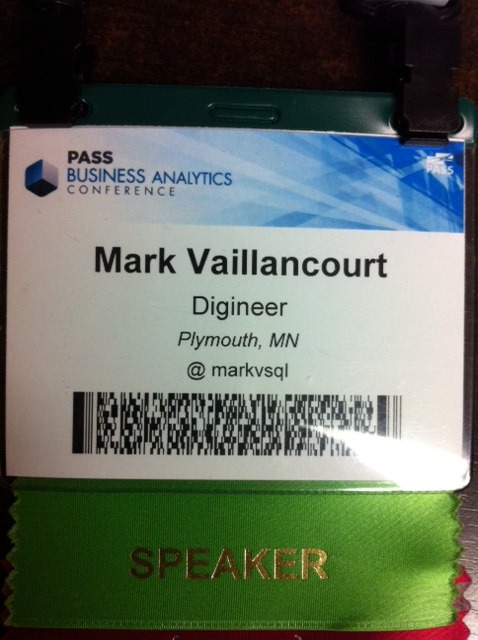
PASSBAC NameTagThe very first PASS Business Analytics Conference (PASSBAC) has come to an end. And it was fantastic. Since you follow my blog with rapt joy, you know that I had the great honor of speaking at this shiny new event. While I have spoken many times to user groups and several SQL Saturdays, it was my first time speaking at an event of this caliber. While I was certainly nervous about presenting, I was even more excited. I LOVE presenting. And I feel comfortable in saying it is something I am pretty good at. While my co-presenter, Doug Lane (b|t), was very appreciative of my asking him to present with me, I must confess that his advice on writing abstracts was invaluable in our getting selected. I met Doug at a SQL Saturday in Chicago a few years ago. It was great to share this honor with a friend from my #sqlfamily. I do want to send special thanks for Joe D’Antoni (b|t) and Scott Stauffer (b|t) for their efforts in coming to my aid the night before the biggest presentation of my career.

Speaking wasn’t the only first for me at PASSBAC, nor was it the only thing I had the honor of sharing with a friend from my #sqlfamily. In 2011, I attended my very first PASS Summit. At that time, I took part in a program for first-time Summit attendees called First Timers. This featured having a Summit mentor as well as taking part in extra networking events. At one of these networking events, I met Angel Abundez (b|t). At PASSBAC, Angel and I both had the honor to be invited to sit at the Bloggers table to Live Blog the keynotes. On Day 1, I sat down next to him and we had a moment of, “Wow, we’ve come a long way in a few years.” You can read Angel’s Live Blogging here. To me, that transformation from First Timer to Bloggers table is more than just the fact that we are both seeing solid growth in our careers. It also speaks of how open and inviting the SQL community is. I often hear that people in other industries and even other groups within the technology sector are just in awe of what we have going on. PASS is an important part of that.

I have to say that I was not only honored that PASS asked me to participate in the Live Blogging of PASSBAC, I was nervous. I had never done that before and wasn’t really all that sure what it would entail. I ended up getting some great advice from John Sansom (b|t) and Jason Strate (b|t). John provided me with a blog post of his about Live Blogging that was really helpful. At the end of that post, John links to a Live Blog from the 2011 PASS Summit by Brent Ozar (b|t). I looked at that post and thought, “Sweet mother of Abraham Lincoln! How can I even come close to matching that?” There are lots of pictures and great commentary. Even if I had convinced my wife to let me take her camera, I would be more likely to drop it on my foot than capture anything of value quickly enough to add it to a live blog post. Then I realized that there was no reason I had to try to match what Brent or any other person had done. I did see that Jason had kept it pretty simple in his Live Blog of the Day 3 keynote of PASS Summit 2011. I figured I would start simple. I set up the Live Blogging plugin for my WordPress blog and decided to try to keep my entries short enough to cross-post them on Twitter. It turns out that was a good choice as so many people told me how much they appreciated what I was doing. I was honestly blown away by the feedback I was getting for my efforts. I even noticed that the PASSBAC homepage was featuring my live blogs of the keynotes. Thanks so much to everyone who followed and expressed their appreciation in one way or another. You can read my Live Blogs from PASSBAC Day1 and Day2. On Day 2, I even got the timestamp working. Yay. As you can see, the keynotes were awesome, from my perspective.

My choice to cross-post to Twitter ended up being a great one from a networking standpoint. It turns out that only the @passbac account itself had more #passbac tweets than I did, according to ExtrendedResults.com, who provided Twitter analysis for the conference. In addition, the analysis performed by iTrendTV showed that I was in the Top 5 in both “Largest Audiences” and “Most Engaging Authors.”  Notice Angel in there with me and some fine company.

My point here is that we need to remember that the I in ROI means “investment.” That investment doesn’t always involve money. Sometimes it means we stray out of our comfort zone or take a risk by doing something new in a public setting. In my case, I was confident that live blogging was a great opportunity that I had to take. I looked at overcoming my trepidation as the investment toward the ROI of increased connections in the industry. I knew that doing a decent job with the live blogging had a good chance of leading to expanding the network of people I value so much.

I had a tremendous amount of fun Live Blogging. I hope I get invited to the Bloggers table for more events in the future.

On the morning of Day1, SQL Sentry hosted a breakfast and informal discussion on Business Analytics emceed by Kevin Kline (b|t). The panel was made up of the following great experts:

Chris Webb (b|t)
Craig Utley (b)
Jen Stirrup (b|t)
Paul Turley (b|t)
Stacia Misner (b|t)

It was great discussion that could have gone on a few more hours and I would have been happy to stay for it. Thanks much to SQL Sentry, Kevin and the great panelists.

I went to fantastic sessions by Jen Stirrup (b|t), Jason Thomas (b|t), Angel Abundez (b|t), Craig Utley (b), Ayad Shammout (b|t) and Denny Lee (b|t), and more. I spent a lot of time learning more about Excel features and geo-spatial topics like GeoFlow.

Overall, the event was just amazing. I am so glad I got to go. The fact that I got to participate in a meaningful way makes it even better. I really want to thank all the people in PASS HQ, Board Members, Sponsors, Program Committee and everyone else who worked so hard to make this event happen.

Upcoming Presentations–April 2013

I have the great joy of presenting at a handful of events in April. I absolution love presenting, so having 3 opportunities to present within the same month is pretty great.

PASS Business Analytics Conference – April 10-12, Chicago IL

Hailing Frequencies: Analysis Services Terms and Concepts

SQL Saturday #211 Chicago – April 13, Chicago IL

Hailing Frequencies: Analysis Services Terms and Concepts

SQL Saturday #175 Fargo – April 27, Fargo ND

MDX Trek: First Contact

If you happen to be attending any of these events, please stop by.

Business Analytics and PASS: Yes Please!

Over the past few years, I have been truly amazed at the power of Business Analytics. I know that part of that is due to my increased exposure to it through client projects. But it seems clear to me that the understanding of what analytics brings to the table has grown as well. One example of the rising prominence of analytics is the fact that IBM is paying out Marketing dollars on prime time commercials about it. From my perspective, that is neither insignificant nor a coincidence.

More and more companies are realizing their data isn’t some static asset that they should just stick onto disks like people used to hide money under their mattresses. It has value far beyond just keeping accounts up to date or being able to how many customers bought Jiffy Pop last week. That is information. And that is certainly important. But analytics takes us to another level entirely.

A client recently told me that his company has gotten really good at measuring operational metrics. Data can help you do that. But analytics can help you determine if you are measuring the rights ones in the first place. Suppose your company can tell the efficiency of Process XYZ with amazing precision and managers all over the company spend a lot of time, both in and out of the office, worrying about how it will fluctuate. Quality business analytics could help you show them how much of an impact Process XYZ actually has on company success. You may end up lowering the company’s overall healthcare costs by preventing a few ulcers.

I am actually just finishing an SSAS 2012 Tabular Model for the Client above in the next couple weeks. It is the first Business Analytics project in his company. It is just a Proof of Concept, and it is not yet complete, but he keeps telling me how valuable it has already been. It is allowing him to correlate data points he never could before. While it is a short project, and the team is just me and a part time PM, I am trying to keep it in the Agile vein and releasing new versions to him every few days or so with new fields, new measures, etc. Within about five minutes after I made the very first release, he told me that he had been able to prove a theory about what was causing a particular business pain, a pain that went up to the highest levels of his company. My point with this is that analytics can often help us see things from different angles or perspectives that are otherwise impossible.

I just can’t wait to get this into that hands of more people in this company. THEN we will really see what, I think, is the greatest benefit that Business Analytics provides: Questions. You read that right. Not Answers. Questions. Answers are great and analytics can provide those. But Questions are the gems. Truly successful business analytics will lead you to the questions you didn’t know to ask. 

I am certainly not the only one who has noticed the rise of Business Analytics. The Professional Association for SQL Server (PASS), which holds a SQL Server Summit every year, announced the first ever PASS Business Analytics Conference taking place in Chicago this April.

PASS BA Conference(b|t)

I have a passion for presenting and my excitement for analytics comes through. I have presented at many SQL Saturdays and various user groups both in person and remotely. When this conference was announced, I knew beyond the shadow of a doubt that I would submit a session or two. I also knew that this was going to be a very long shot for me. The competition would be VERY stiff and, being the first event of this kind for PASS, there would be a lot of people vying for spots to present. I couldn’t believe it when I got the email that one of those sessions I submitted was accepted. It will be the crowning achievement of my Presenting career to date. I will be co-presenting with a friend of mine, Doug Lane (b|t), who I met at a SQL Saturday event in Chicago a few years ago.

Our session, Hailing Frequencies: Analysis Services Terms and Concepts, is a Star Trek themed introduction to the terminology and ideas that are an important foundation for Business Analytics projects using Microsoft SQL Server Analysis Services as the technology of choice. We will be focusing on SQL Server Analysis Services 2012 and covering both the traditional Multidimensional Model (Cubes) as well as the new Tabular Model. The increased demand for analytics will lead to more and more analytics projects. Yes, I put that together all by myself. As such, it is important for people to have an understanding of what they are getting into and start off on the right foot.

There are so many amazing sessions at this conference. In addition to having the privilege of speaking, I am really excited to be counted as an attendee. Here are just a few of the many sessions that I am particularly excited about.

Dave DuVarney (b|t) of SolidQ is giving a session: Delivering Agile BI Solutions. I firmly believe that analytics projects are iterative and work best when users and stakeholders get their hands dirty early and often. This will provide awesome insight into how to handle this well.

Cindy Gross (b|t) of Microsoft and Eduardo Gamez of Intel are presenting: How Intel Integrates Self-Service BI with IT for Better Business Results. One of my first projects in my SQL Server career was designing/implementing a SQL Server Reporting Services Report Model for enable power-users at a client to create their own reports. Ever since then, I have been a proponent of empowering end users as part of an overall reporting solution. This session looks to be a magnificent look into how a highly respective organization like Intel was able to create a holistic solution with great success.

Marco Russo (b|t) will be delivering a session on: Modern Data Warehouse Strategy. In his abstract for this session, Marco points out that new technologies around Self-Serve BI and Big Data Analytics are not doing away with the concept of a Data Warehouse, “but we do need to update our strategy for data warehouse implementation to fit the requirements of this new era.” I am still relatively new to Data Warehousing in general so I expect to get a massive benefit from this session. Marco’s blog and book, Microsoft SQL Server 2012 Analysis Services: The BISM Tabular Model, have been of enormous help to me on my current Tabular Model project.

There are 60 sessions in all. Sixty. I am just ecstatic that PASS saw the value in holding an event like this focusing on Business Analytics. I feel so honored that I get to be a part of it.

If you work in a company that has data, then you work in a company that is likely to benefit from Business Analytics. We, as a global community are producing and consuming ever increasing volumes of data and at increasing speeds. Analytics is no flash in the pan; it is here to stay and the appetite for it will only get larger. The sooner you start learning about it, the better. The PASS Business Analytics Conference is an excellent place to start. You can register here. Your career is worth the investment. Who knows? Maybe you could end up leading your company (and yourself) into an era of better insight and success than ever before.

Who’s Got Two Thumbs And Is Speaking at the PASS Business Analytics Conference?

PASS_BAC_Logo_JPEGThat would be my friend, Doug Lane (b|t). Oh, and me, too. We are actually co-presenting a Star Trek themed session: Hailing Frequencies: Analysis Services Terms and Concepts.

Abstract:

In this Star Trek-themed presentation aimed at non-technical folks, we will explain the terms and concepts important to understand when participating in projects involving SQL Server Analysis Services (SSAS). You’ll learn the key differences between the SSAS Multidimensional Model (Cubes) and the SSAS Tabular Model. You’ll also learn the definitions and examples of key terms for each model, including but not limited to: measure groups, measures, dimensions, attributes, and hierarchies in the SSAS Multidimensional Model and tables, columns, and calculated measures in the SSAS Tabular Model. We will also demonstrate the basics of browsing of both Multidimensional and Tabular models using Excel 2013.

This conference has an amazing list of speakers.

image

The fact (no pun intended) that my name is among this group of fantastic presenters from Microsoft and the SQL Community is pretty overwhelming. And the fact that I get to share this opportunity with a friend I met at a SQL Saturday is just that much better.

Summing Up PASS Summit 2012

I attended my second PASS Summit this year. And my experience, once again, was awesome. This year was definitely a different kind of awesome, though. Last year, I was a First Timer and was awesomely overwhelmed at pretty much everything. This year, I was a First Timer Mentor, helping a group of First Timers learn the ropes and get their feet wet in the most excellent SQL Training event there is. This year was my first Summit as a PASS Regional Mentor. So, I had some official stuff I needed to do like attending the Regional Mentors meeting and the Chapter Leaders meeting and spending some time helping out in the Community Zone (a new feature this year). I also had the change to sit down with Chris Shaw (b|t), the other Regional Mentor for Canada, and several of our Canadian Chapter Leaders for an in-person meeting to talk about the challenges they face and how we, as Regional Mentors, can help them out. That was fantastic. Particularly since Canada is so vast, and Chris and I both live in the US, it was an amazing opportunity.

I also volunteered as an Ambassador, helping answer questions and direct people to where they need to be. It was my involvement this year that made such a difference for me. Putting together an event like the PASS Summit is a massive undertaking. Even though my part was miniscule, I felt honored and proud to help out a community that means so much to me. I also got to meet the AWESOME people of PASS HQ and do what I could to make their time a bit easier.

The sessions I attended were really cool and I cannot wait to start watching the session recordings. I met a lot of new people, including Buck Woody (b|t) and Denny Lee(b|t) and so many others for the very first time. I got to spend time with so many people who I rarely see. There are too many to name that fall into this category. SQL Karaoke was EPIC and frequent. That was just awesome to do karaoke to a live band. Just. Awesome.

I was asked recently what my biggest takeaway from Summit 2012 was. It only took about 1 second to come up with the answer, “Community.” This year, for me, was more about the Community than anything else.

I have to send out a hekaton of thanks to PASS HQ, the sponsors, speakers, volunteers, vendors, Microsoft, and everyone else who made the 2012 PASS Summit just friggin awesome.

Oh, and it took all week, but on Friday, I finally managed to juggle three of the full-sized beanbag chairs in the Community Zone.

SQL Saturday Nashua (146) Recap

FenwayGateBOn October 20th, I had the pleasure to attend SQL Saturday 146 in my hometown of Nashua, NH. To speak in the vocabulary of my youth, it was wicked good. I have decided to have parts of this post be in Bostonian, the dialect of English that is common in a pretty wide radius around the fine city of Boston, MA. I will note the Bostonian sections by using the <Go Sawx!> tag at the beginning and the ending tag of </Go Sawx!>.

I know that Fenway Park is actually in Boston, but the majority of people in southern NH are Red Sox fans. In the interest of full disclosure, I have to come clean: I married a Yankees fan.


<Go Sawx!>

The Speakah Dinnah was on Friday night, and it was a wicked pissah. Meetin’ Mike Walsh (blahg|Twittah) and Jack Corbet (blahg|Twittah) for the first time was awesome. It is so much fun meetin’ people you have only chatted with on Twittah and stuff. I also got a meet a ton of new people and have a really good Seafood Samplah. It was a sweet time. And the SQL Satuhday hoodie all the speakahs got is spectaculah.

</Go Sawx!>

Saturday, I showed up early to help set up the PASS table and staff it with mighty Joe D’Antoni (blog|Twitter). As two PASS Regional Mentors, part of our job is to help out with the PASS table at events like SQL Saturdays. I spent pretty much all of my time there when I wasn’t in a session (or the bathroom, but we won’t go into that). I had a great time chatting with the attendees about PASS. The overwhelming majority of the attendees said it was their first SQL Saturday. It was fantastic to see the enthusiasm of people so new to SQL events.

I gave my MDX Trek: First Contact presentation during the first session of the day. It went well and I had good questions asked. It was really fun and I got some great feedback. Thanks to those who attended and endured my Star Trek nerdery.

I then sat in on Matt Masson’s (blog|Twitter) EIM – Bringing Together SSIS, DQS, and MDS session. I had not seen much of Data Quality Services before. That was pretty cool and great to see those tools put together to great effect.

I spent the third session hanging in the speaker ready room with Bill Pearson (Twitter), Andy Roberts (blog|Twitter) and Slava Kokaev (blog|Twitter). It was great to just sit and relax a bit and chat about Business Intelligence.

The fourth session of the day for me was with Bill Pearson in his Overcoming Barriers and Avoiding Mistakes With BI presentation. It was actually more of a group discussion format. That was cool and a refreshing change from the typical presentation format.

<Go Sawx!>

The aftah pahty was at a restarant called Mahtha’s Exchange (Martha’s, actually). I hung out with some really cool people and had killah appatizahs. It was low key and just really fun. Any chance to spend time with othah SQL people is a great time. Oh, and that Peanut Buttah Pie was frickin awesome, guys.

</Go Sawx!>

Mike and Jack put together one great SQL Saturday. The feedback from attendees and presenters alike was overwhelmingly positive. With the help of awesome volunteers like David Taylor (blog|Twitter) and so many others, SQL Saturday 146 in Nashua a great success.

SQL Saturday Minnesota (149) Recap

My customary post-SQL-Event post is a Top Ten List. I have decided that I do not wish to be bound by the limitations of the number Ten. Therefore, from here on out, my plan is to do a more free form recap.

SQL Saturday #149 just took place in Minneapolis, MN, on September 29th. There were also some Pre-cons offered on September 28th. I shall arrange my recap chronologically.

September 28th

I attend the Unlocking Insight – Be a Data Hero pre-con given by Dan English (b|t) and Brian Larson. The content was on the BI stack in SQL Server 2012, with special focus on Tabular Models and Power View. I got a lot out of it and had fun, to boot. Nice work, gents.

I had to miss the Speaker Dinner this time around. But, if you will bear with me, I will imagine some events that may or may not (likely not) have taken place:

Llama1. Jason Horner (b|t) showed up riding a llama he personally befriended while on a hiking trip through the Andes. Her name was Gertrude and her ability to juggle was astounding.

2. Jason Strate (b|t) decided to challenge Gertrude to a game of chess. Fortunately for Jason, Gertrude’s hastily constructed Sicilian Defense was no match for his knights. Well done, Jason.

3. Jes Schultz Borland (b|t) demonstrated that she can actually levitate over a stack of SQL Server books by uttering a very long, high pitched, “SQUEEEEEEEEEEEEEEEEEEEEEEEEEEEEEEEEEEEEEEEEEEEEEEEEEEEEE!” It was truly impressive to behold.


September 29th

I attended the POSH Eye for the BI Guy presentation given by Jason Horner (b|t). It was about using Powershell for managing objects in SSIS, SSRS, and SSAS. Jason showed great agility by doing an impromptu intro to Powershell when he learned that the vast majority of the attendees had never used it. I really enjoyed it and am looking forward to playing with Powershell to do all kinds of cool stuff with the BI tools.

I attend the Design and Implement BI Like Edison session by Bill Pearson (t). He did a great job combining fascinating facts about Thomas Edison with Business Intelligence. It was a lot of fun.

I helped Mike Donnelly (b|t) distribute lunches to the experts in the lunch breakout sessions called “Topics on a Stick,” which is a great reference to the numerous stick-bound foods one can get at the annual Minnesota State Fair. I then hung out at the PASS table with Sarah Strate (b|t) to have my lunch and do my part as a PASS Regional Mentor.

I had the honor of giving my MDX Trek: First Contact presentation. I have a blast with this one. Thanks to all who attended and for the great feedback.

I attended the session called Fast Track to Spatial Reporting by Jason Thomas (b|t). Jason did a great job explaining the use of spatial data with Reporting Services 2008 R2. As someone who has only done basic stuff with maps in SSRS, I found it really helpful.

For the final session of the day, I went to Real-Time Analytics With SSAS Tabular DirectQuery by Paul Doyle (t). It was a really interesting look at the DirectQuery option for the new Tabular models in SSAS 2012. Paul and a colleague demonstrated how to set it up, track it using Profiler, and went over some of the caveats. It was a good session on a new topic for me. Nice work, gents.

The after party was a great time. I hung out with old friends and made some new ones. There was SQLKaraoke, which is always a good time. The SQL Saturday after-parties are just awesome. Spending time with the fine folk of the SQL Community is just awesome.

That pretty much wraps it up. Huge thanks to everyone who worked so hard to make this event the great success that it was. The people who give so much of their time and energy to put on events like SQL Saturday are truly an asset to the SQL Community and deserve way more recognition than they tend to receive.

Professional Development Plans: Turning Your Job Into a Career, Part 2

Long ago in a galaxy far far away, I blogged about my Professional Development Plan (PDP). That really was a long time ago: May of 2010. Wow. I want to provide an update on my own PDP and reiterate their value. I also have a few tips to share.

Updates From Last Time

1. One of my PDP goals at that time, as I was really starting to delve deeper into Business Intelligence, was to pass the 70-448 Microsoft SQL Server 2008, Business Intelligence Development and Maintenance. I did that. I have since achieved my MCITP in 2008 BI by also passing 70-452 PRO: Designing a Business Intelligence Infrastructure Using Microsoft SQL Server 2008. I work for a consulting firm. Certifications are an important part of Microsoft Partnership criteria for our organization. So, certifications certainly do matter here. They also help me by serving as a measurement of my learning. I know there are people who feel that certifications have no value whatsoever since some people have learned how to game the system and get certified with little to no effort or experience. I think it is short-sighted and unfair to dismiss their value. People have learned how to steal cars relatively easily, but that does not invalidate car ownership. Now, I’m not saying that certs are everything by any means. A cert is no guarantee of aptitude, but neither is it meaningless.

2. I explained my personal goals of establishing myself as an expert and being an active member in the SQL Community. I had also listed the MVP Award as a goal. As I had explained in my previous PDP post, the MVP itself was not truly a goal, but rather would a possible side-effect of achieving my personal goals of community support and expertise. Since the MVP is an award, and not something with a definitive roadmap, having it as a goal is silly. I have removed that. Don’t get me wrong, it would be cool. But MVP is something that happens to you, not something you go get in a definitive fashion.

New Goals

Sextants and Compases1. It was back in May of 2010 that I fully decided to pursue Business Intelligence as a career path. I have learned a lot since then and have been on an engagement dealing directly with SSAS since December. I am loving it and learning more every day. I am also learning about Master Data Services (there will likely be a presentation/blog series on this in the future). I have started learning MDX and even presented on it several times. My goal is to keep forging ahead with the SQL 2012 BI tools including Power View (which is just friggin awesome) and the new SSAS Tabular Model. There’s just so much to learn. Dig it!

2. Blogging. Yeah. I have on my PDP a goal to blog twice per month. Well. Yeah. Not doing so hot on that one. I am doing better than I have in that past, but many of my posts of late have been about upcoming presentations. Those are important to me, but I promise I have some cool content coming. I am planning some blog series and I also have another writing project that I am working on that I am not ready to discuss yet.

3. Presenting. I have had on my PDP for some time that I want to present at least 3 times per year. Well. I have knocked this one out of the park. I have already done more presenting in 2012 than in the previous years of my career combined. And I intend to keep it up. I don’t think I am being overconfident when I say that presenting is something I have a talent for. Absolutely loving it helps a lot, too.

4. PASS Regional Mentor. I spent 3 years on the executive board of the Minnesota chapter of PASS, PASSMN. I have taken a few years off from that and now I am anxious to get back into community involvement. I would like to try something different this time around. My favorite part of community involvement is helping people and evangelizing SQL Server the SQL Community. RM seems a great fit for that. Thus, earlier this week, I let SQLPASS HQ know of my desire to become a PASS Regional Mentor. I am looking forward to hearing back about interviewing for the role. I am really excited about the possibility and feel that I could do a great job.

PDP Tips

Road Signs1. My original PDP post was in May 2010. It is now July of 2012. More than two years. In that time, my maintenance of my PDP has been less than awesome. I have also had periods in there, some long ones, actually, where no PDP progress was made at all. This brings me to my first tip: Cover Your Nut. That is an old Sales adage. It means, above all, do at least enough to pay your bills and maintain the status quo. There were periods where it took everything I had just to do my daily work and extra stuff just didn’t happen. There will be times when going above and beyond is just too far above and beyond what you are able to do. I urge you to be OK with that at the time. Doing more than you can handle is not a sustainable behavior; it will just lead to burnout. That said, get back to your PDP and making steps toward your goals when you can.

2. Find a mentor. Your mentor does not have to be someone older or a wizard or anything. It really can just be someone you discuss your PDP and your goals with. Having someone like that can help you stay on track and even offer advice on steps to take, etc. My own SQL Server consulting career started when Lara Rubbelke (b|t) hired me at Digineer. Lara was a great mentor for me. When she moved on to Microsoft, direct mentorship became a bit more difficult, although it is still great to chat with her about my career every now and then when we can. The person filling the role of my mentor today is Jason Strate (b|t). His knowledge of SQL Server is really impressive and he has a willingness and a knack for helping people out. I get a lot of good advice from him on blogging, presenting, and networking, as well. When it comes to more Business Intelligence focused topics, Dan English (b|t) has helped me out as well. After seeing my MDX Trek: First Contact presentation, he emailed me some valuable feedback that helped me polish it up. All of the people mentioned above have great expertise and are more than willing to share.

3. The best PDP related tip I can give is this: HAVE A PDP. It does not have to be anything especially rigid or come with drill sergeant. But working toward turning your job into a career is a lot easier when you know what you want that career to look like.

I’m going to try to be better about keeping my PDP updated. I will also make sure my next PDP update blog post doesn’t take over two years to happen.

Facing The Challenge: Designing a BI Infrastructure With SQL 2008 (70-452)

On Monday, Feb 6th, I passed exam 70-452, Designing a Business Intelligence Infrastructure Using Microsoft SQL Server 2008. Hazzah. I am really excited about that, not because I get a shiny new MCITP certification, but because it validates how much I have learned. When I started working with SQL Server about 5 years ago, I started down the DBA track, even earning an MCITP in the SQL Server 2005 DBA track. It was not too long after that when I determined that Business Intelligence was where I really wanted to hang my career hat.

This post isn’t really about that, though. I have a process that I use to learn the material. I then use the exams to measure that learning. The process I have has worked pretty well. Actually, I am 6 for 6 when I commit to this process. Since it seems to work really well for me, I thought I would share it in case it may help someone else as well.

Typically, I like to use the Microsoft Press Self-Paced exam guides. I find them to be a great starting point and cover the key areas of the technology in question. In the case of exam 70-452, as of the time of this writing, there is not a Microsoft Press exam guide for that exam. Therefore, I instead chose Delivering Business Intelligence with Microsoft SQL Server 2008 by Brian Larson. I found it to be a great base for my prep for 70-452. In areas where I felt I needed to go deeper, I turned to Books Online.

My process consists of a few key steps.

1. I go through the text taking notes on the details of each topic. I make sure to make my notes in my own words and avoid taking anything word for word from the text. This helps a lot in that I must process the information more than once as I go.

2. The books I have used have all featured do-it-yourself style exercises during which you put what you learned into practice. I find this really valuable to gain at least some experience, particularly with skills I have never used in real life.

3. I read through the notes several times over, just like studying for test back in school.

It does not seem like much and certainly is not very elaborate. There are no tesla coils involved or anything. But sometimes it is the simple things people overlook.

Since I titled this post “Facing The Challenge,” I figured I should also show some of the faces I used during the process outline above.

 Confusion. Some of the content was confusing at first.


 Determination. I knew I had to commit myself to understanding all the concepts.


 Realization. Ah. NOW I get it.


 Blue Steel.


 Satisfaction. I passed. I dun learned something.


Well, there you have it.

PASS Summit 2011 Top Ten List

After I come back from an event, whether I presented or not, I like to write up a Top Ten List of my experience. These are not necessarily ranked in order of importance; they were all cool. And there were awesome experiences that could not make the list due to limitations of the number Ten.

photo

Behold!

10. Guidebook App

Mobile phone users (aka anyone with a pulse) were able to use an app called a Guidebook to track the schedule, speakers, exhibitors, etc. This meant that I was able to easily build my own schedule of the sessions I wanted to attend as well as fill out my evaluations online. There were configurable reminders to make sure I didn’t forget something I had put on my schedule. It was also easy to keep track of any updates to the schedule during the event. Especially for a noob like me, this app was awesome.

9. SQLKaraoke

SQLKaraoke is just fun. When you’re not singing, you get to hang out with really cool people. I have a background in Theater and Improvised Comedy, so SQLKaraoke is a total blast for me. Since I’m well…a little different, I actually use SQLKaraoke as a networking tool. I like to make up SQL-related spoofs and even do an impression or two. This time around, I ended up performing The Bangles Eternal Flame as Gilbert Gottfried. Yeah. It was pretty silly. But it ended up being a huge boon in terms of networking. People who I have long followed and respect were introducing themselves to me instead of the other way around. I was “the karaoke guy.” Bottom line: be creative in your networking. Creative use of your strengths can pay off really well for meeting new people.

8. Women In Technology Luncheon – Make Yourself HeardLadiesRoomSign

This was totally a great way to meet girls. <pause>

Seriously though, this is an event really designed to help women continue to gain more traction in the workplace. Things are certainly a lot better than they used to be (my wife just started watching Mad Men), but I think we can all agree that true equality isn’t there yet. I was excited to see there were a LOT of men in there (and not just to meet girls). The wisdom shared by the panel is applicable to everyone. It was just a great experience.


7. Exhibitor Hall

I’m a nerd. I like hardware and software. I like stuff. There was all of that in here. You know the old saying, “run around like a kid in a candy store?” Well, this was more like a mall full of candy stores. Mmmmmmmm.

6. Peoples

A huge part of the Summit is networking. Meeting other people. I met so many awesome SQL professionals from around the world. It was just unreal how friendly people were. First Timers, like myself, were made to feel so welcome. I spent meals, walks (there was a LOT of walking), evenings, some events, just meeting and chatting with great folks. There were too many fantastic people to list.

5. “Preventing the Oh, Poop! Reporting Situation.”

SQL Server MVP Jessica Moss (Blog | Twitter) delivered this session. She demonstrated the out-of-the-box methods that Reporting Services provides for tracking the performance of your reports. This included how to determine that a report returned no rows (CEO’s LOVE that, right?). She also demonstrated a cool meta-report solution (reports about reports) you can use to keep an eye on things. It was cool to see a presentation about Report management to complement the ones about building them.

4. A Little Help From My Friends

My friend, Jes Schultz Borland (Blog | Twitter), gave a session called “Reporting Services 201: From Basic To WOW!” She gave some great tips on report authoring and really explained the Tablix well for anyone that was new to it. She discussed features such as the Tooltip and the NoRows message. These are things that are easily overlooked but can really enhance the user experience when implemented well. Squeeeeee! (translation of “Squee”: Hi, my name is Jes and I presented at the Summit!)

My friend, Doug Lane (Blog | Twitter), gave a session called “Developers Are From Mars, Report Servers Are From Venus.” Mr. Lane gave some valuable tips and tricks on Reporting Services through the lens of a marriage. He included the “mother-in-law always comes along” feature of the extra pages you sometimes get in SSRS and how you can often solve that with the ConsumeContainerWhiteSpace property.

Awesome

NOTE: This image has nothing to do with this post. But, it’s cool so I put it in anyway.

3. Dr. David DeWitt: “Big Data – What is the Big Deal?”

On Friday, Dr. DeWitt gave his keynote, this time on Big Data. As stated earlier, my background is in Theater and Improvised Comedy. I cannot remember any of my acting classes in involving huge quantities of data. And, never having dealt with VLDBs at all in my career, the concepts related to Big Data were pretty new to me. But here is the thing: I understood this keynote. That surprised me. I expected to get lost pretty quickly. Rather, I was able to follow along due to the excellent way in which Dr. DeWitt explained it. This was not merely a presentation on Big Data, it was also a master class in how to be a great presenter.

2. BISM (BI Semantic Model)

I have done a lot of work with Report Models and enjoy dealing with tools that can enable end users. I am excited to deal with BISM and help people get their own data. Why give people a fish when you can plant a potato? Wait… Yeah. You certainly don’t plant the fish…

1. Power View (Project Crescent)

Along the lines of letting users get their own data is the fabulous Power View (formerly known as Crescent). This thing is friggin cool. That’s totally industry speak, by the way. The idea of Two Clicks To ROI is just a great way to make things easy. Essentially, no feature in Power View is more than two clicks away. It is just so easy to use and gorgeous to behold. I can’t wait to really get in and play with this fabulous tool. Keep in mind that it complements the existing tools; it does not replace any of them.


The PASS Summit was an amazing experience. If you ever get the chance to go, grab onto it with both hands.